
Start a Cumberland Property Search
A good Cumberland County property search moves from the easiest identifier onward. It ends at the record with legal weight. The Property Valuation Administrator, or PVA, is the practical first stop for an address. It also serves an assessment owner or a parcel number. That parcel number then bridges to the County Clerk's deed and mortgage index. A deed book and page often beats a broad name search. Current tax collection sits with the sheriff. Delinquent bills move to the clerk and the state process after transfer.
Each source has a narrow job. PVA cards are assessment aids. Clerk instruments document what was actually recorded. Tax lists show collection status at a stated time. Map lines help orient a tract but never replace a survey. Write down the record date and identifier at every step.
- Select Kentucky and Cumberland County PVA at the Schneider qPublic/Beacon entry, then try the address, name, parcel ID, and alternate ID modes.
- Copy the parcel/account number, owner field, location, description, and any sale book/page exactly as displayed.
- Use the book/page or party names in the County Clerk record system to locate the latest instrument.
- Check the correct tax year with the sheriff or the clerk's delinquent-tax materials, depending on transfer status.
- Request an official copy, plat, or older volume from its custodian when the web route stops.
Cumberland County Records Custodians
Three offices hold the core Cumberland County property records. The County Clerk records deeds, mortgages, easements, liens, lis pendens, and plats. The PVA keeps parcel assessment data. It also holds owner and mailing information, property class, land and improvement details, and sales records. The sheriff begins county property tax collection. Delinquent tax bills transfer into the clerk and state process. Calling the right office first saves a failed request.
Cumberland County Clerk
601 Courthouse Square, P.O. Box 275
Burkesville, KY 42717
270-864-3726
Cumberland County PVA
600 Courthouse Square, P.O. Box 431
Burkesville, KY 42717
270-864-5161
Cumberland County Sheriff
600 Courthouse Square, P.O. Box 838
Burkesville, KY 42717
270-864-4321
Cumberland PVA Search Modes
The qPublic and Beacon entry offers five useful modes. These are search all, search by name, search by address, search by parcel ID, and search by alternate ID. The county does not publish a direct link to its live Cumberland application. So choose Kentucky and Cumberland County PVA at the vendor entry. Login, signup, and purchase controls may appear along the way. None of that changes the PVA office's role as the county contact for assessment questions.
| Search key | Best use | What to retain |
|---|---|---|
| Address | Known road or situs | Exact location and parcel ID |
| Owner name | Known person or entity | Name spelling and mailing field |
| Parcel ID | Cross-system match | Leading zeros, hyphens, suffix |
| Alternate ID | When supplied on a card | Both identifiers |
The PVA search entry is a finding tool, nothing more. If it does not return the county result, call Gina Shaye Watson's office or request the assessment card by parcel and address.
A Zero Can Still Be Property
A Kentucky Public Service Commission filing includes qPublic card examples for Cumberland County. One location field reads "HENDRICKS CREEK RD 0." That zero is a local records clue. It is not proof the tract lacks land, access, or value. Rural cards sometimes carry a road-only location. The deed holds a metes-and-bounds description, and the mailing address points elsewhere.
Keep location, description, mailing address, and legal description as separate fields. A normal street search can fail. Try the parcel number, the owner mode, an old route name, a town or ZIP, or the E-911 mapping route. This small quirk explains many false "no record" results.
Note: A road-only PVA label should never be replaced with a guessed house number.
Clerk Images and Access Gates
The Cumberland County Clerk recording page explains that instruments receive book and page numbers. They are indexed. They are also scanned into the online county-record system. Deed images are available there, and mortgage images reach back at least thirty years.
The portal sits behind a Courthouse Computer Systems login. Search fields and any digital cutoff depend on what the county releases through that account.
The recording page shows the route. The portal's gate sits at this link: Open the Cumberland clerk access gate to reach the county-record system itself.
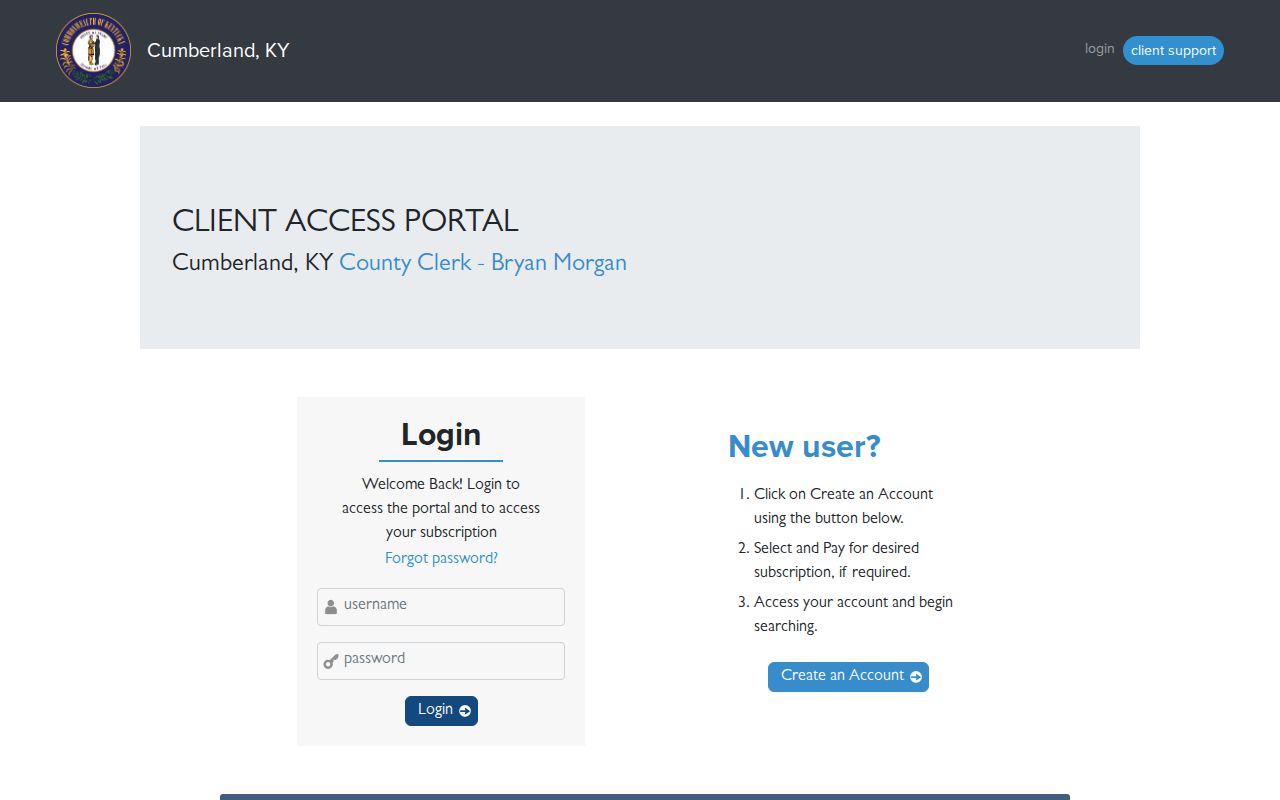
That gate is exactly why book and page numbers, an in-office index check, or a clerk copy request still matter whenever anonymous web access falls short.
Cumberland Property Record Types
Cumberland County property records work as a linked set. A single parcel can carry an assessment card, one or more recorded deeds, mortgages and releases, yearly tax roll entries, map geometry, plats, and court or probate references. No single row answers every ownership, value, or boundary question.
| Record Type | What It Documents | Kept By | Access |
|---|---|---|---|
| Deeds and plats | Transfers, descriptions, lot or tract references | County Clerk | Portal gate, counter, phone, written request |
| Mortgages and liens | Recorded security interests and notices | County Clerk | Index and instrument image |
| Assessment | Parcel, owner, class, land, improvements, sales | PVA | qPublic entry or office request |
| Property tax | Current collection or delinquent certificate status | Sheriff, then Clerk | Office and clerk tax page |
| City permits | Municipal application, zoning, inspection clues | Burkesville | Forms page and records request |
Start with the record that matches the question. A deed shows the recorded transfer. An assessment card gives the parcel's tax identity. A plat or survey supplies boundary detail. A tax list cannot establish title, and a permit never replaces a deed.
Cumberland Assessment Calendar
Kentucky requires annual real-property assessment and places physical inspection on a four-year cycle. The Department of Revenue describes sales comparison, cost, and income methods. It also covers agricultural value and exemption routes. Cumberland's PVA keeps the parcel-level value, while the state explains the process. Requesting a card or comparable sales is not an appeal. It does not pause any appeal deadline.
The Kentucky assessment process page lays out how the state reaches those values.
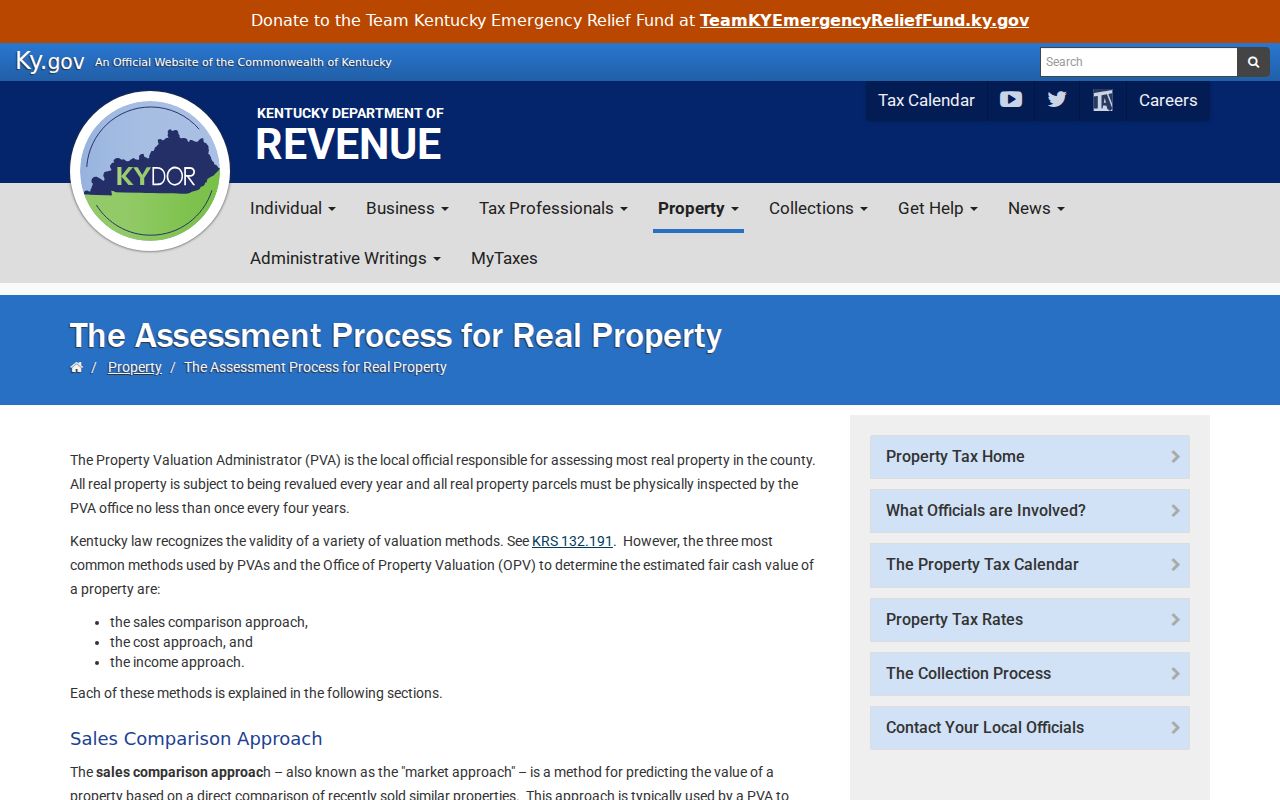
That state explanation gives useful context for the PVA value without turning it into a sale-price estimate or an appraisal.
Cumberland Tax Record Handoff
Property taxes in Cumberland County start with the sheriff. Unpaid bills move to the county clerk at close of business on April 15. That handoff follows the Kentucky Department of Revenue's schedule. The clerk then owns delinquent collections. Its delinquent-tax page carries purchaser instructions, registration material, templates, and posted open-bill files. Dates on those files are just that. A 2025 open-bill PDF documents one cycle. A September 11, 2025 Cumberland sale date does too. Neither is a 2026 schedule.
Work from the official delinquent-tax page. Note the tax year, and ask whether the bill was paid, transferred, assigned, redeemed, released, or followed by a deed. A name on the delinquent list proves no abandonment, vacancy, or clear title.
Burkesville Records Fit Inside
Burkesville is Cumberland County's only incorporated city. Even so, countywide records reach land inside the city limits. PVA, clerk, sheriff, and court property records all apply. Municipal files answer different questions. The Burkesville forms catalog posts an open-records request, a building permit, and a 2025 property-tax document. It also posts the city ordinances. Think of it as a download shelf, not a parcel database.
A parcel inside city limits needs the county packet. Then pair it with any permit, zoning, or city tax file. Outside the line, don't route a county question to Burkesville. A mailing address, city limits, and county-seat status are distinct. They are three different facts about the same land.
Cumberland Maps Need Context
Cumberland County publishes no direct public parcel GIS map. For a parcel number, the PVA remains the route. Road names and emergency address points fall to the county E-911 mapping coordinator. The Kentucky Geological Survey map layers in the Cumberland River, Dale Hollow Lake, roads, and communities. That is physical context, not a tax-parcel layer.
Water and road changes happen over time. They can make an old legal description look nothing like a modern address. Compare any parcel polygon against the recorded deed and plat. Keep the stream, road, adjoining-owner, and prior-book references intact. A line on a map proves no frontage, lake access, easement, or ordinary high-water boundary.
Cumberland Deeds Cross Time
Cumberland County was formed from Green County in 1798. Parts of it later became Wayne, Monroe, Russell, Clinton, and Metcalfe land. An early tract may sit under a parent county. The Kentucky Department for Libraries and Archives advises searching both grantor and grantee indexes. Then work backward through prior deed references. When the chain breaks, other records help. Tax rolls, estate files, and sheriff or commissioner deed categories can bridge the gap.
Burkesville grew on Samuel Burks' land and served as a riverport. That history explains deed terms tied to a landing, ferry, mill, timber tract, or watercourse. Treat the context as a search clue. That is not proof an old feature sat on today's parcel.
Request Missing Cumberland Records
Kentucky residents can request Cumberland County public records under KRS 61.872 by hand delivery, mail, fax, or email. No special form is needed. A written request should name the custodian, the parcel or address, the owner or entity as indexed, a date range, the record type, and a preferred format. Ask for inspection or copies. The agency does not have to create a new report.
KRS 61.874 governs copies and permits advance payment. When a Cumberland County office lacks a record, ask that office to identify the proper custodian. If part of a record is exempt under KRS 61.878, request the reasonably separable, nonexempt portion. That fallback matters whenever the clerk gate, the county PVA route, or an older archive cannot be searched online.
Cumberland Court Property Records
A deed search can find a name. It rarely explains how the transfer occurred. Foreclosure, quiet-title, partition, boundary, and probate files may hold the missing order or estate trail. CourtNet offers statewide public case information. The Administrative Office of the Courts keeps no local file. Request Cumberland files from the Circuit Court Clerk at the Justice Center, 112 Courthouse Square. Cite the case number, party names, court division, and filing range.
A foreclosure lead deserves the full paper trail. Pull the complaint, mortgage and assignments, judgment, sale order, commissioner report, confirmation, and final distribution. For probate, request the will, inventory, settlement, orders, and any deed of distribution. Read both with care. A complaint only states allegations. A probate order may not show the final recorded transfer. Pair the court file with the clerk's deed index.
Older files may sit in the State Records Center. Ask the local clerk for a locator number before contacting the center. Some cases also fall under a retention schedule. That keeps a missing online docket from looking like a missing Cumberland County property record.
Cumberland Parcel Identity Records
A Cumberland County property search goes smoother when every identifier sits on one sheet. Start with the PVA parcel ID and account. Then record the displayed location, description, assessment owner, and mailing name. Add the class, tax district, and assessment year. Finish with the latest deed book and page or instrument. Then add the prior deed reference and any plat citation.
Tax work needs its own details. Jot down the year, bill number, transfer status, and certificate data. Court, permit, and business searches each need a case, permit, or entity number. This packet prevents a familiar local mistake. Records get joined only because two owner names happen to look alike. The sheet keeps parent and child parcels intact after a split.
Preserve punctuation and leading zeros in any number. Match the format shown in Cumberland PSC exhibits. Save the source URL, access date, and screenshot beside each value. Lake and river parcels need extra care. If the parcel touches Dale Hollow Lake or the Cumberland River, add the map source and date. Keep water geometry apart from the deed calls. When a road name changed, keep the historic wording beside the current E-911 and USPS labels. Let the packet expose conflicts rather than erase them.
Limits of Cumberland Property Records
Cumberland County property records can do a lot. They identify an assessment owner, a deed grantee, or a recorded lien. They also show a tax status or a mapped parcel. They cannot prove who lives at a mailing address. Nor can they guarantee that every interest was recorded. An online index may not be current. A tax-map line is not a legal boundary. A filed complaint is not always a judgment.
Some doors stay closed. Safe at Home substitute-address rules can restrict what a search returns. So can sealed files, vital-record limits, and Kentucky privacy exemptions. Keep any lookup tied to a valid parcel, deed, tax, boundary, estate, or civic question. Verify any legal decision with the custodian and the correct certified record.
Lawful use. Cumberland County records support due diligence, boundary work, tax review, and history. They must not be used to stalk, harass, or target anyone.
Older Cumberland County deeds and plats can predate everything now online. Call the County Clerk. Bring a known owner, a date span, and a book or page clue. KDLA's Research Room may hold microfilm or archival material, but its general deed guide promises no specific Cumberland volume. Search both grantor and grantee indexes.
A deed lacking a prior reference still leaves paths. Tax records, estate files, and adjoining owners all work as search aids. H, C, and S categories mark deeds from heirs, a commissioner, or the sheriff. Address problems belong to the office that owns the field: USPS for delivery format, E-911 for emergency address points and road names.
The PVA links a location to its parcel card. Burkesville keeps municipal limits and city land-use files. The County Clerk preserves the recorded legal description. One system's fix may never reach the others. Retain each reply with its date and parcel ID. Before relying on any Cumberland County property record, recheck the office page, portal access, and stated date.