
Reading Cumberland County Property Tax Records
Assessment and collection live in different systems in Cumberland County. The PVA parcel card defines the tax parcel and holds the valuation facts. The sheriff's record shows whether the current tax bill was paid or still owed. Once an unpaid bill transfers, the Cumberland County Clerk's certificate becomes the trail to follow. The delinquent-tax files carry it forward from there. Match the parcel ID and tax year across all three. That beats a name match alone, which catches similar owners too easily.
| Tax record item | What the entry means | Official holder |
|---|---|---|
| Parcel and account IDs | Keys that connect the assessment, deed lead, map, and bill | Cumberland County PVA |
| Assessment fields | Class, tax district, and land or improvement data used in valuation work | Cumberland County PVA |
| Current bill status | The year, amount, payment, or balance held during initial collection | Cumberland County Sheriff |
| Delinquent certificate | The transferred unpaid bill and later payment, assignment, or redemption trail | Cumberland County Clerk |
| City property tax document | A separate municipal record for property within Burkesville's jurisdiction | City of Burkesville |
An assessed value is not a sale price. A posted bill is not a title report. Transfers, corrections, exemptions, and late payments update one system before another catches up. Keep a dated copy of each result and ask the custodian to explain any mismatch.
Cumberland County Property Tax Search Fields
The PVA search begins at the Schneider qPublic/Beacon enterprise entry. There is no stable direct Cumberland application URL. Pick Kentucky and Cumberland County PVA at that screen. Search one field at a time. Keep the punctuation in a parcel number exactly as written.
| Search mode | Best input | Useful result |
|---|---|---|
| Address | Street number and road name, then variants | Parcel and location match |
| Name | Owner or entity as indexed | Assessment owner and mailing fields |
| Parcel ID | Full ID with zeros, hyphens, and suffix | Exact parcel card |
| Alternate ID | County alternate identifier when supplied | A second route to the same card |
The portal also offers an all-fields option and account controls. Treat those as index aids only. For the assessment record itself, or any correction, the PVA office remains the source.
How Cumberland County Sets the Assessment Year
Kentucky Department of Revenue guidance applies statewide. It describes real property as assessed every year. Physical inspection runs on a four-year cycle. That cycle does not hand every parcel a new sale-based figure every fourth year. The PVA can weigh cost, sales comparison, or income evidence as the property warrants. Farmland follows its own state valuation rules. For the process and current forms, use the Kentucky real-property assessment guide. The official state page displays the full assessment framework.
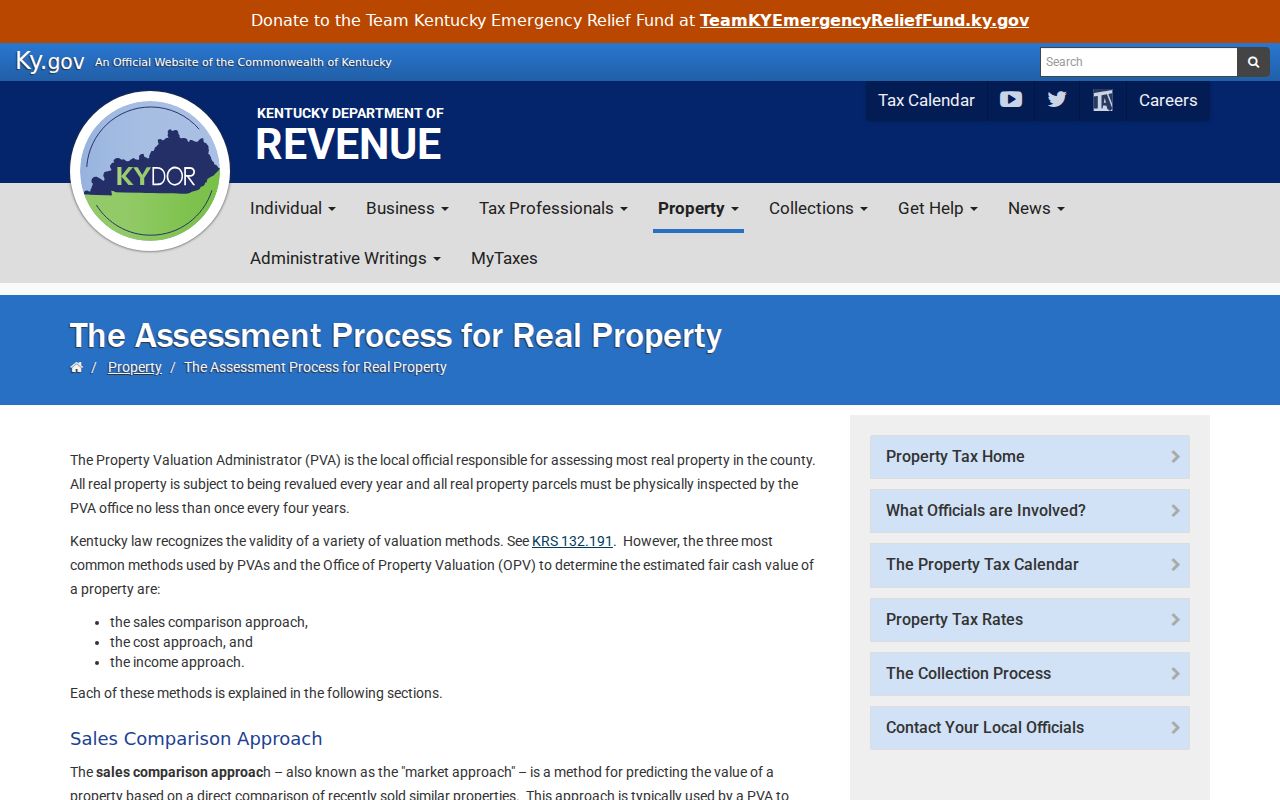
State guidance sets the framework. The Cumberland PVA owns the parcel card, the assessment year, the land and improvement breakdown, and the comparable sales behind a value. Asking for information never extends an appeal deadline.
Follow a Cumberland County Property Tax Bill
A complete Cumberland County property tax lookup tracks the bill by year and by custodian. Skip the old sale lists. Establish the parcel and its assessment first, then ask whichever office handles the bill at that stage.
- Find the parcel ID and current assessment through the PVA entry, using address, owner, parcel ID, and alternate ID as needed.
- For a current bill, contact the Cumberland County Sheriff and give the parcel ID, owner as displayed, and tax year.
- For an unpaid bill after transfer, check the clerk's delinquent-tax page and confirm the certificate number and live status with the clerk.
- Record payment, transfer, assignment, redemption, and any later deed as separate events. Never treat a list appearance as the final status.
- Assessed value
- The value entered by the PVA for property-tax administration.
- Levy or tax rate
- The rate applied by a taxing authority to the relevant tax base.
- Homestead or disability exemption
- State-authorized relief claimed through the prescribed form and eligibility process.
- Tax lien
- A legal claim tied to unpaid tax; its status requires current confirmation.
The Cumberland County Sheriff-to-Clerk Handoff
The sheriff collects first. Kentucky DOR rules send any unpaid bill to the county clerk at close of business on April 15. After the transfer, the certificate runs through the clerk. Added costs, any assignment to a third-party purchaser, and redemption history run through the clerk too. A transfer alone does not mean a sale will happen. The Cumberland County Clerk delinquent-tax page posts a listing link, purchaser forms, and dated open-bill material. So a visitor can recognize the county's own workflow.
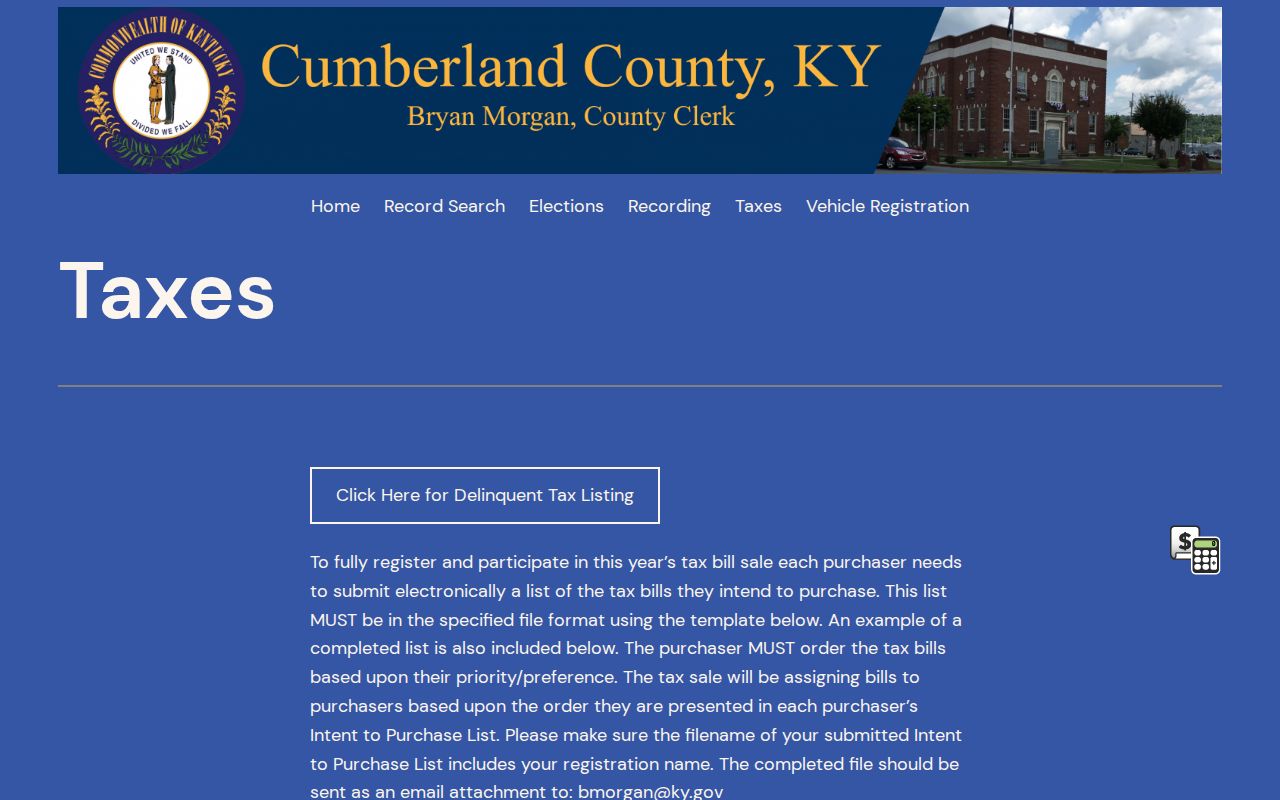
Treat that page as a route to dated documents, not proof that a named parcel is unpaid today. Confirm the year, certificate number, payment, assignment, and redemption with the clerk.
A Dated Cumberland Tax List Snapshot
Cumberland's clerk page posts an open-2025-bills document. A state DOR update listed the county's 2025 sale for September 11, 2025. Both are year-labeled historical sources. Neither gives a 2026 schedule or a current answer for any parcel, which is exactly why property tax records carry time stamps.
Check the live status. Payment, an installment agreement, correction, bankruptcy, assignment, or redemption can alter what a dated list seems to show.
The clerk's purchaser spreadsheet and registration form explain procedure, not results. Ask for the current list or certificate status instead of reusing a prior-year file.
Burkesville and Cumberland Property Tax Differ
Burkesville's official forms page posts a city property-tax PDF alongside other municipal forms. That document answers a different question from the countywide PVA assessment. It also differs from the sheriff's bill or the clerk's certificate. A Burkesville mailing address proves nothing about city limits either. Check the county parcel first. Then open the City of Burkesville forms catalog once municipal jurisdiction is confirmed. County and city records can coexist. Neither substitutes for the other.
Challenge a Cumberland County Property Tax Assessment
A value dispute runs on Kentucky's assessment calendar. It also depends on the local conference and board process, and later state appeal routes. Ask the PVA first for the parcel card, the year at issue, property characteristics, and comparable sales. Fix factual errors before anything else. Then gather photographs, a survey where relevant, repair evidence, and comparable sales tied to the valuation date.
Use the current calendar. Kentucky appeal periods and forms are time-sensitive; verify the year's dates with the Cumberland PVA and Department of Revenue before filing.
DOR names forms such as 62A350 for homestead or disability treatment and 62A023 for exempt property. Check the current version and eligibility terms yourself. A public-records request is not an appeal and stops no clock.
Get Cumberland County Tax Records Offline
The portal is not the only way to reach Cumberland County tax records. For assessment matters, contact PVA Gina Shaye Watson at P.O. Box 431, 600 Courthouse Square, Burkesville, KY 42717, 270-864-5161, or GinaL.Watson@ky.gov. Her office handles parcel cards, assessment fields, and corrections. Current bill collection belongs to Sheriff Keaton Williams, 600 Courthouse Square, P.O. Box 838, Burkesville, KY 42717, 270-864-4321. Delinquent bills that were transferred raise different questions. Those go to County Clerk Bryan Morgan at 601 Courthouse Square, P.O. Box 275, Burkesville, KY 42717, 270-864-3726 or bmorgan@ky.gov. His office also handles purchaser material and certificate status. Confirm office hours before you drive over.
Cumberland County Levy in Audit Records
A 2022 audit by the Kentucky Auditor of Public Accounts examined the Cumberland County sheriff's tax settlement, offering a clear picture of one completed local cycle. The audit states that assessments were levied on January 1, 2022, covering taxes billed for the fiscal year ending June 30, 2023. Several other milestones appear too. Unpaid bills were transferred on January 4, 2023. Collection ran through August 31, 2023, and a statutory add-on was applied under KRS 134.119(7).
These dates apply to that audited levy alone. Copying them into a current-year checklist would be a mistake, and they never override the Department of Revenue's general April 15 transfer guidance. What the audit really shows is that levy date, billing period, transfer, lien, and collection are separate events in the life of a property tax record. Anyone researching a Cumberland County parcel should request the settlement or tax-year record covering the exact year in question.
Request Missing Cumberland County Property Tax Records
When a portal comes up empty, do not stop there. Send a focused request to the office that actually holds the record. Include the parcel ID, bill or certificate number, tax year, and owner of record as shown. State whether an inspection or an electronic copy is wanted. Ask the sheriff directly whether a current tax bill was paid or transferred. Ask the clerk whether a certificate was paid or assigned. Ask whether it was redeemed. Ask whether it still sits under that office's control.
Kentucky's open-records law shapes these requests. KRS 61.872 lets a state resident ask for public records by hand delivery, mail, fax, or email. The requests are subject to exemptions. No special form is required. KRS 61.874 governs copies and permits advance payment in appropriate cases. Those rules supplement rather than replace the clerk's routine process for everyday tax documents. They also never force an office to build a new analysis. If the recipient is not the custodian, request the good-faith referral the statute requires.
File the response with the parcel identifier and the lookup date. An office reporting no result is not the final word. Check the year and an alternate parcel number. Check the transfer status too. Only then conclude that no bill or certificate exists.