
Run a Cumberland Property Search
A good Cumberland County property search builds a chain of identifiers. Start at the PVA when you know an address or owner. Copy everything the card offers: parcel number, account, location, description, class, tax district, owner, mailing address, and any sales book and page. Then take that parcel number to the clerk's deed records for the latest transfer. Tax and court lookups come last, since each needs its own year, bill number, party name, or case number. Never merge records just because names look alike. Dates and exact identifiers settle the question. That matters with entities and estates. Parent parcels, road-only locations, and land split from an older tract raise the same risk.
- Normalize the street number, road name, locality, ZIP, and any old route name without changing the legal description.
- At the Schneider entry, select Kentucky and Cumberland County PVA, then try address, name, parcel ID, and alternate ID.
- Save the parcel/account number and every displayed field with the date of access.
- Follow a sale book/page into the Cumberland deed system, or search the present owner as grantee.
- Check the matching tax year, mapping clues, and any court or city record needed for the question.
- Ask the PVA or clerk for inspection or a copy when the web route is blocked.
Cumberland PVA Search Fields
The qPublic and Beacon surface offers several entry points. You can search all records at once. You can also search by name, by address, by parcel ID, or by alternate ID. Reach the Cumberland site through the vendor's state and site selection. There is no published direct link. Treat any login, account, or purchase controls as portal conditions, not county copy fees.
| Mode | Enter | Best next key |
|---|---|---|
| Address | Street number and road | Parcel ID |
| Name | Person, estate, trust, or entity | Owner spelling |
| Parcel ID | Full punctuated number | Book/page |
| Alternate ID | Card's alternate identifier | Account number |
The online search does not always cooperate. When that happens, the Cumberland County PVA at 270-864-5161 serves as the fallback for assessment questions. Call with the address in hand, and include the parcel ID if you have it.
Read Cumberland Card Results
A qPublic card filed with the Kentucky Public Service Commission shows what to expect. It lists parcel number, account, location, description, class, tax district, primary owner, mailing address, land, improvements, sales, photo, and announcements. The card also carries a warning. It is not for use on legal documents. Read it as an interface guide, not as proof of who owns a parcel today. The PVA entry screen shows the route a Cumberland County property search takes. It is where you get started.
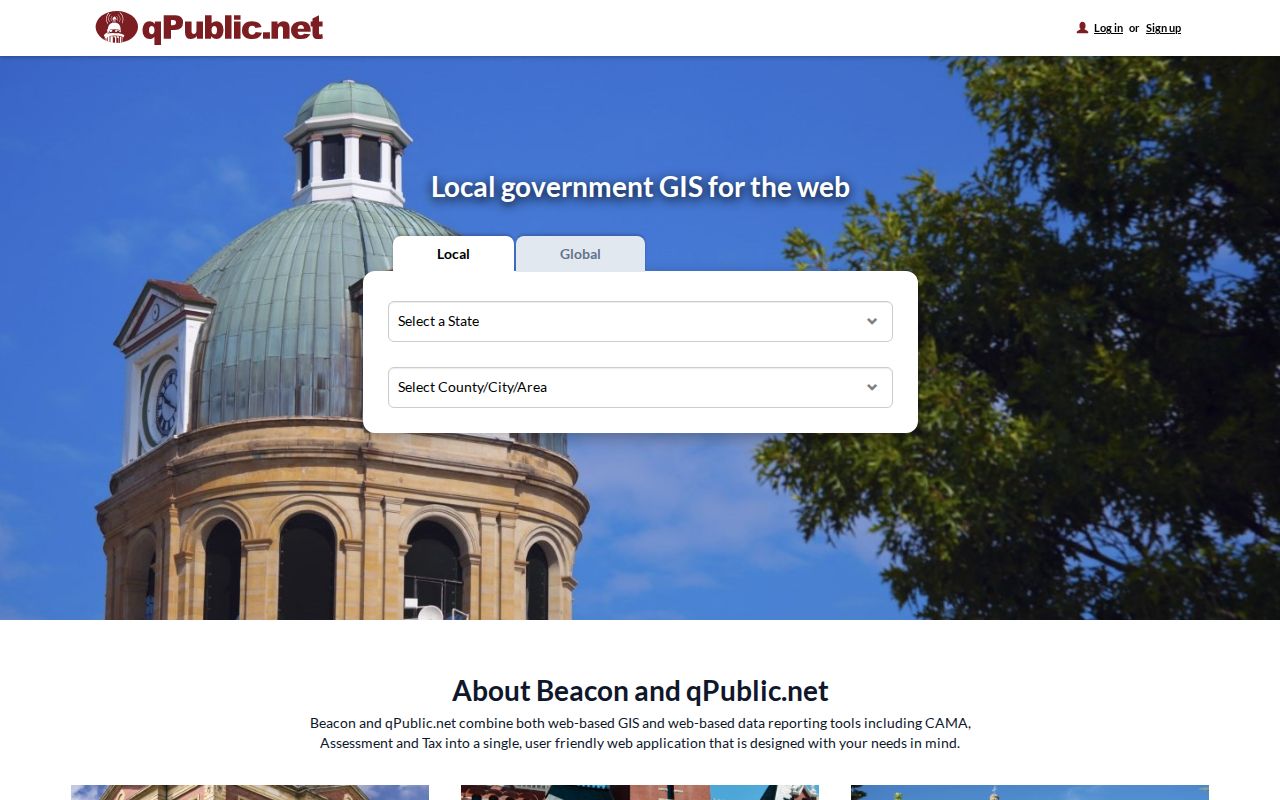
The entry screen walks you through state and site selection. The county publishes no stable direct URL for Cumberland results.
Cumberland Address Fields Differ
One parcel can carry several addresses. The situs or location field places the land itself. A mailing address is where notices go. It may point to an owner's home, an agent, a business office, or another state. An E-911 address supports emergency routing, while a USPS result standardizes delivery. The deed's legal description identifies the land through tracts, bounds, lots, watercourses, or prior recordings.
- Parcel ID
- The PVA's main bridge between assessment, map, and tax work.
- Situs
- The location label, which may differ from mailing data.
- Owner of record
- The name carried on the current assessment roll.
- Book/page
- The clerk reference used to retrieve a recorded instrument.
Keep these fields apart. A tidy mailing label proves nothing about municipal limits, occupancy, or title.
What Cumberland Search Results Show
A first result is an inventory, not a final answer. Record every value with its source and date. The PVA roll updates on its own schedule. It runs apart from the clerk's deed index, the sheriff's collection record, or a city permit file. So a recent deed can name a grantee before the assessment owner ever changes.
| Owner and mailing | Assessment name and notice address |
|---|---|
| Parcel and account | Keys for PVA, map, tax, and requests |
| Location and description | Road label or short tract notation |
| Class and tax district | Assessment labels, not zoning |
| Land and improvements | Inputs for valuation review |
| Sales rows | Date, price, parties, and book/page leads |
No card tells the whole story. Easements, mortgages, releases, estate orders, and boundary calls stay inside the instruments themselves, so pull the cited document whenever the answer depends on its terms.
Cumberland Deed Verification
The clerk assigns every recorded real-estate document a book and page reference, then indexes and scans it. The office's own page names deeds, mortgages, liens, lis pendens, plats, powers of attorney, and other instruments. The live Courthouse Computer Systems gate exposes no reliable search fields. So do not count on a free anonymous index or any particular coverage year. Work the deed records methodically instead. Search the PVA owner as a grantee, then the prior seller as grantor. Try punctuation and suffix variants for an LLC or corporation. When a card supplies a book and page, start there. If the portal blocks access, call the clerk at 270-864-3726 or visit the index at 601 Courthouse Square during listed hours.
The Hendricks Creek Zero
One PSC exhibit card lists the location as "HENDRICKS CREEK RD 0." Another pairs a Cherry Tree Road location with a mailing address somewhere else. Together they prove the point. Road, legal ownership, and mailing fields cannot be flattened into a single address. A zero in the location field can simply be a rural convention. It is not a failed property search. When an address returns nothing, strip the suffix or unit. Then try the road nickname or old route number. Then switch to owner and parcel search modes. Marrowbone may appear as a postal or local place. The parcel may still sit outside Burkesville. Ask E-911 about address-point history and the PVA about parcel-to-address identity.
Cumberland Tax Status by Year
Start each tax year with the sheriff. After the Kentucky April 15 transfer point, delinquent bills move into the County Clerk process. The clerk tax page posts purchaser templates, registration forms, and dated open-bill material. It is not a title system. Write down the tax year, bill or certificate number, transfer date, purchaser or assignment, release, and current payment or redemption status. Dated lists change. The 2025 sale notice cannot stand in for the 2026 schedule, and an open-bill row says nothing about vacancy or final ownership.
Escalate a Failed Search
A dead end in a Cumberland County property search is rarely final. The spelling of an owner's name may vary from deed to deed. A parcel may sit under an older parent tract. Its deed may also rest in a book the county has not digitized. Some Cumberland County property records respond only inside a permitted portal session. So treat silence as a lead rather than as an answer.
- For an address failure, try owner, parcel, alternate ID, road nickname, town, and ZIP.
- For a deed gate, send book/page and a date range to the clerk.
- For an old deed, check parent counties and KDLA holdings.
- For a name conflict, add entity ID, parcel ID, book/page, and dates.
- For an address conflict, keep USPS, E-911, PVA, city, and deed values separate.
A failed search is not the end of the road. Under KRS 61.872, you can submit a clear written request for any record that is not posted online. Hand delivery, mail, fax, and email all qualify.
Compare Cumberland Search Keys
Every search key has a weakness. An address reads easily but streets get renamed. An owner name can pull up several parcels. It can also miss a deed recorded under an entity variation. A parcel number is the most precise key for the current tax unit. Yet a split or merge may force you back to the parent ID. So confirm identity with at least two keys before deciding two records describe the same land.
| Key | Best use | Primary source | Risk |
|---|---|---|---|
| Address | Known road or site | PVA | Old names and zero-number fields |
| Owner name | Known person, estate, or entity | PVA and Clerk | Initials, suffixes, trusts |
| Parcel ID | Exact current tax unit | PVA and tax | Splits, merges, parent IDs |
A Cumberland County property search you can reproduce beats one you cannot. Save the source URL, the date, the key you typed, a screenshot, and the result identifier. When a key fails or a legal question turns on the deed itself, call the custodian of the property records.
Not a title search. A Cumberland County property search finds assessment and recorded clues. It does not guarantee clear title or settle a boundary.
Cumberland Court and Entity Searches
Some Cumberland County property searches move past the parcel and deed indexes. A company, bank, contractor, or assumed name on a deed sends you to the Kentucky Secretary of State business database. Match the exact legal name and entity status. The UCC index lists financing statements by debtor name or filing number. Remember that a UCC filing is a state lien record. It is not a county real-estate mortgage search.
Foreclosure, quiet-title, partition, and boundary disputes live in CourtNet. They also live with the Cumberland Circuit Court Clerk. Search by party name. Pleadings often identify land only by deed, tract, or parcel rather than street address. Note the case number, division, dates, status, and disposition. Then request the complaint, exhibits, judgment, and orders from the clerk. A docket line is only an index. It cannot replace the case file.
Estate ownership demands two sources read together: probate records and the deed index. The phrase "Estate of" on a PVA card does not prove a probate case is still open. Confirm the distribution through the court file and a later recorded deed.
Build a Cumberland Search Log
Any Cumberland County property search should be repeatable months later. Log the source name, exact URL, access date, query mode, text entered, and result ID. Add the parcel or account number and the deed book and page. Add the tax year and bill number, court case number, and permit number. Include the entity ID as each appears. A screenshot helps only while its source and date stay attached.
Conflicting sources should be kept, not reconciled by guesswork. An assessment owner carries an assessment date. A deed grantee carries a recording date. A tax balance belongs to a tax year and status date, and a permit applicant may not be the owner of record. The log keeps those roles from collapsing into one false statement.
Name the custodian in each written request. It works best when it describes the record narrowly: parcel or address, indexed name, date range, and preferred format. If the office does not hold the record, ask who does. Kentucky's open-records route opens doors to property records. It does not make an agency research them for you.
Cumberland Map and City Fallbacks
A map result still calls for restraint. Cumberland County publishes no public parcel GIS endpoint, layer schema, download format, or adjacent-parcel tool. For official parcel identity, fall back on the PVA and the county E-911 mapping contact. The Kentucky Geological Survey map orients roads and communities. It also shows the Cumberland River and Dale Hollow Lake. It cannot draw a legal parcel boundary. Check any mapped polygon against the deed and the recorded plat.
Burkesville adds one more path for land inside the incorporated city. Its forms catalog posts a building permit, an open-records request, and a city tax document. It also posts the ordinances. The catalog is not a parcel search. Request a completed permit or zoning file by parcel, address, applicant, project, and date range. For land outside city limits, stay with the Cumberland County and state routes. A Burkesville mailing address does not prove city jurisdiction.
Keep a plain note of what each Cumberland County property search did not cover. A blocked deed gate or missing parcel layer is a known limit. It is not an invitation to guess. The named custodian is always the correct next step.