
Cumberland County Deed Types
The Cumberland County Clerk records far more than deeds. A deed conveys the interest its text describes. A mortgage secures a debt instead of transferring land. An easement grants someone a defined use of the property, while liens and lis pendens give public notice of claims or pending lawsuits. Plats and corrective instruments round out the set. Read them together, because a deed that looks clean can still point to limits buried elsewhere in the land index.
| Deed Type | What It Does | Common Use |
|---|---|---|
| Warranty deed | Conveys the stated land with promises written into the deed | Ordinary purchase and sale |
| Quitclaim deed | Conveys whatever interest the grantor has, if any | Family transfer, divorce, or title cleanup |
| Corrective deed | Corrects an error while pointing back to an earlier instrument | Name, description, or recording correction |
| Executor or commissioner deed | Conveys through an estate or court-authorized sale | Probate, partition, or judicial sale |
| Sheriff deed | Records a transfer tied to an authorized sale process | Tax or court process, subject to the underlying file |
The deed type alone never settles title. Work through the granting clause, legal description, exceptions, reservations, signatures, acknowledgments, and prior-record references. Then chase later corrective instruments and any related releases before you trust the chain.
Cumberland Deeds at the Clerk
The Cumberland County Clerk Recording Department gives each lodged document a book and page. The document then enters the index. Real-estate recordings are scanned and digitally indexed. The published record set covers deeds, mortgages, powers of attorney, lis pendens, and liens. It also includes papers that help genealogical work. The official recording page itself identifies the local department that keeps Cumberland County deed records.
A deed's parties and land terms still come from its own indexed image. The recording page mainly introduces the office and its process. The office sits at 601 Courthouse Square in Burkesville, with mail to P.O. Box 275, Burkesville, KY 42717. The published phone is 270-864-3726, fax is 270-864-5884, and email is bmorgan@ky.gov. County materials list weekday hours of 8 a.m. to 4 p.m. The elected-official page adds Saturday 8 a.m. to noon. Confirm hours before you go. Bring the sharpest clue you have. A party name works. So does a date range. A parcel ID, deed book and page, instrument number, or legal description all work too. A known book and page is the fastest bridge. Use it when the web portal will not open. Ask whether a plain image suffices or the job needs a certified copy.
Cumberland County Digital Deeds
The clerk links to the Courthouse Computer Systems Cumberland portal. Its access gate stops public viewing before the search fields appear. So do not assume particular field names or a date cutoff. The clerk does state that deed images are available. Mortgage images reach back at least 30 years. That statement does not promise every old book, plat, or oversized exhibit is online. The official recording page offers the sensible fallback: contact the office about current subscription, payment, browser, or in-office access. Keep the URL and date of any failed attempt. A portal denial is never proof that Cumberland County deed records are missing.
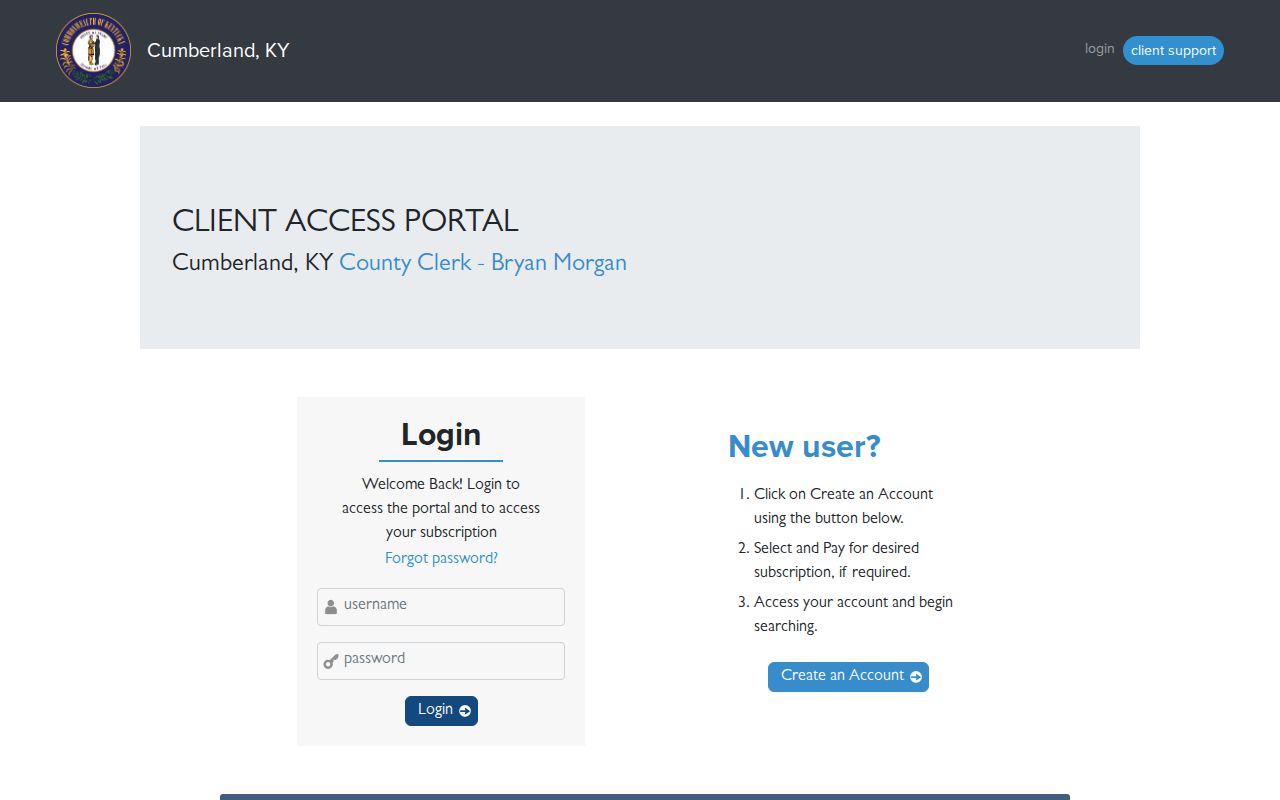
That gate explains why a book-and-page request to the clerk remains a key path when public web access stops at authentication.
Trace Cumberland Deeds by Name
A grantor-grantee search follows people or entities through the index. Start with the newest conveyance you know. A PVA sales row may supply a book and page, but check the recorded image, because a sales row is assessment data rather than the full deed. Search exact names plus reasonable variants covering initials, punctuation, corporate suffixes, trusts, and estates.
- Locate the latest deed with the current owner as grantee, or use a known book and page from the parcel card.
- Read the deed image. Save execution date, recording date, grantor, grantee, deed type, legal description, and every prior reference.
- Search the named grantor as a grantee to locate that party's acquisition. Match the land description, not just the name.
- Repeat backward. When a normal name trail stops, check heirs, commissioner, sheriff, estate, and court records.
- Track each parcel separately if one deed covers several tracts or if a parent tract later split.
- Grantor
- The party conveying the stated interest.
- Grantee
- The party receiving the stated interest.
- Chain of title
- The linked run of conveyances for the same land.
- Book and page
- The clerk's location reference within recorded volumes.
- Instrument number
- A separate identifier that a recording system may assign.
Read Cumberland Deed Images
The index only gets you to an image. The image supplies the proof that the hit concerns the right land. Compare recording dates with execution dates. Copy names as written, including middle initials, suffixes, estate labels, trustees, corporations, and "et al." Preserve the full legal description before you summarize. Check acreage, metes and bounds, lot or block, roads, watercourses, adjoining owners, exceptions, easements, rights-of-way, mineral or timber reservations, life estates, and references to earlier deeds or plats. A stated consideration is not always a market price. A nominal amount may mark a gift, a correction, a family conveyance, or a deal whose value goes unstated. Marginal notes and later filings matter. A mortgage may be assigned or released. A deed can be corrected. A lis pendens points to a lawsuit but never reveals the winner. Search each referenced record before you draw any title conclusion.
Cumberland Plats Behind Deeds
A recorded plat sits behind many Cumberland County deeds. It can spell out lot dimensions, road dedications, easements, common areas, adjoining lots, phase names, and a surveyor's certification. The clerk treats plats as part of the real-estate record set. However, the county publishes no separate public plat viewer and no stand-alone plat-index scheme.
Ask the clerk for the plat book and page. Also request the subdivision or survey name. Oversized documents may need special handling. If a name search stalls, try the developer or owner of record instead. A road or tract description helps too. Lay the recorded plat beside the PVA parcel shape. But remember the tax-map polygon does not preserve survey bearings or monuments.
Note: No official countywide subdivision list exists, so a marketing name is not a recorded subdivision until a plat proves it.
Cumberland Deeds Before Digital Indexes
Kentucky Department for Libraries and Archives deed guidance notes that Kentucky land records predate statehood. Searchers work both grantor and grantee indexes. The KDLA Research Room holds microfilm. Its Cumberland County roll and book coverage is not itemized. Call 502-564-1770 with the county, record type, year, and any known reference.
Cumberland County formed from Green County in 1798. Land later split off to Wayne, Monroe, Russell, Clinton, and Metcalfe counties. So an early tract may live in a parent county's deed books. Deeds before roughly 1890 can carry inconsistent prior-book references. When an instrument cites no source, KDLA suggests pairing tax records with adjacent-owner clues.
Old Cumberland County deed indexes also lean on letter shortcuts. H marks heirs, C marks commissioner deeds, and S marks sheriff deeds. These headings can restart a broken chain of title. Treat them as hints, though. Each indexer applied them differently, so inspect the actual index pages.
Cumberland River Deed Clues
The Kentucky Historical Marker for Cumberland County recounts Burkesville's 1798 layout on Samuel Burks' land. The town grew into a riverport shipping timber and farm goods. That past shaped local deed records. Old Cumberland County instruments often describe land by a ferry, landing, mill, warehouse, timber tract, river bend, or farm name. They rarely name a street address.
The Cumberland River and Dale Hollow Lake explain part of the puzzle. An antique description may not match today's road map. Keep the old place terms intact. Pair them with adjoining owners when searching. Then compare the deed and plat against the current parcel. An aerial image alone proves nothing about shoreline title or access.
Request Cumberland County Deed Copies
Start with the online image when one exists. Otherwise inspect the index at the clerk's office. You can also call 270-864-3726, mail a focused request, or email the recording contact. Say exactly what you need: inspection, an electronic image, a plain paper copy, or certification. Ask for the current fee and postage quote, since the clerk posts no published deed-copy schedule.
A strong request names the grantor or grantee. Give a date range. Add any parcel number, address, or book-and-page reference. You may ask for deeds, corrective deeds, mortgages, assignments, releases, liens, lis pendens, easements, plats, and powers of attorney, including items in separate or oversized series. Under KRS 61.872, a Kentucky resident may submit a public-record request by hand delivery, mail, fax, or email, though the clerk's recording desk may follow its own copy process.
Want a full ownership history rather than one instrument? Use the backward method on the Cumberland County former owners page.
Recorded, not guaranteed. A Cumberland County deed index shows what reached the public record. It is not a title opinion, and unrecorded or misindexed interests may exist.